
Close on the heels of one per cent cut in interest rate on small savings scheme and PPF in the Union Budget, the Reserve Bank of India announced on Friday a 0.5 per cent reduction in interest rate on savings account to 3.5 per cent effective Saturday
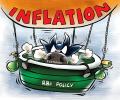
The Reserve Bank on Friday retained its inflation projection for current fiscal year at 6.7 per cent amid global geopolitical developments triggered by Russia-Ukraine war. RBI Governor Shaktikanta Das said the impact of inflation globally is weighing heavily on the domestic market. For September quarter of 2022-23, RBI projected retail inflation at 7.1 per cent.

The global financial services major had earlier said that the central bank would keep its policy rates on hold.

Banks have not cut rates yet as March is typically a busy season.

Battling a sharp surge in inflation, the Reserve Bank is all for a smooth monetary policy response and the desire to have smaller hikes led it to tighten the policy in an off-schedule meet, a source said on Thursday. Inflation has been massively impacted by Russia's invasion of Ukraine and will in due course also reflect the dent caused by Indonesia banning palm oil exports, the source aware of central bank thinking said, indicating that there was no other option but to respond. "The idea is to have a smooth policy response, not to put in large cold turkey responses," the source said, making it clear that the preference is for smaller magnitude responses and not larger ones.

With RBI likely to make credit costlier and banks to follow, some ideas on switching money to be able to do this.

RBI has pegged the GVA growth of 7.6 per cent for the current fiscal and 7.9 per cent the year after
The Reserve Bank of India has left the bank rate and repo rate unchanged at 6 per cent and 4.5 per cent, respectively.

Bajaj Finance was the top gainer in the Sensex pack, rising around 4 per cent, followed by Maruti, SBI, Bajaj Finserv, Sun Pharma and Asian Paints. NSE Nifty rallied 293.05 points to 17,469.75.

Both the RBI and the central government should see that the transmission of the rate reduction by the banks happens soon, otherwise the whole exercise is futile, says Subramanian MV.
The Reserve Bank of India on Friday raised the benchmark lending rate by 50 basis points to 5.40 per cent to tame inflation.
Reliance Industries was the top gainer in the Sensex pack, rallying nearly 4 per cent, followed by Infosys, Tech Mahindra, HCL Tech, TCS and L&T.

RBI is closely monitoring monsoon.

The Reserve Bank on Wednesday hiked key benchmark policy rate by 25 basis points to 6.5 per cent, citing sticky core inflation. This is the sixth time interest rate has been hiked by the Reserve Bank of India (RBI) since May last year, taking the total quantum of hike to 250 basis points. Announcing the bi-monthly monetary policy, RBI Governor Shaktikanta Das said the Monetary Policy Committee (MPC) by a majority decided to raise the policy repo rate by 25 basis points and keep a 'strong vigil' on inflation outlook.
State-run Bank of India said on Thursday it will lower some deposit rates by 25-50 basis points from June 7.\n\n\n\n

It has been decided to reduce home loan rate by 20 basis points.

All public sector banks have moved to such a regime voluntarily, while private banks are yet to. The state-run banks have introduced repo-linked products for floating-rate home and auto loans, but the RBI said loans to micro, small and medium enterprises (MSMEs) should also be linked to an external benchmark.

According to Soumya Kanti Ghosh, chief economic advisor of the State Bank of India group, a 50 bps rate cut is a possibility, but 25 bps is more likely.

By taking the mutual fund route, investors can take exposure to gilts with small amounts. Over a decade or more, returns from these funds tend to be sound.
Equity indices made an emphatic comeback on Friday after falling for seven straight sessions after the RBI hiked interest rates by 50 basis points on expected lines and projected inflation coming under control from January next year. A strong recovery in the rupee added to the momentum, traders said. Overcoming a wobbly start, the 30-share BSE Sensex soared 1,016.96 points or 1.80 per cent to settle at 57,426.92. During the day, it rallied 1,312.67 points or 2.32 per cent to 57,722.63.

The Reserve Bank of India cut its repo rate by 25 basis points to 6.50 per cent.

From liquidity, monetary policy operations to financial inclusion, know about RBI monetary policy

Indian Bank expects recoveries to be more than slippages in this financial year, which will result in improved asset quality.

Analysts are divided on their retail price inflation forecast, with some saying the first quarter numbers will overshoot the RBI target by as much as 60 bps while others are softer in their estimate. Consumer price inflation retreated from its 15-month peak of 7.4 per cent in July to 6.8 per cent in August, much lower than the market expectations, despite vegetable prices remaining elevated at 26.1 per cent. Food inflation eased to 9.9 per cent from 11.5 per cent, led by some cooling of inflation in vegetables, cereals, pulses and milk.

The repo rate or the short term lending rate was increased to 7.5 per cent from 7.25 per cent.

The NSE Nifty, after shuttling between 10,698.35 and 10,587.50, finished the session 91.50 points, or 0.86 per cent higher at 10,684.65.

A CRR cut will help banks to reduce lending rates.

Rajan announced a status-quo on interest rates.

The methodology will be announced later this week.

RBI has also announced new guidelines to price loans from April 1.
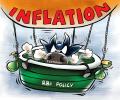
Analysts say RBI will cut rates because the liquidity crunch that began this time last year is still hurting the economy and also with an eye on the August industrial production numbers, which showed a contraction by 1.1 per cent -- the steepest in seven long years.

If credit is not going to flow in response to a policy rate cut, while inflationary pressures, as well as expectations, may be stoked, a rate cut may not be appropriate at this point

Realty sector is facing a huge slowdown for last 3-4 years, leading to a significant delays in possession of flats to customers.

The Reserve Bank may cut key interest rates as early as this week.

The central bank had revised its inflation forecast significantly downward in the last policy
Better supply management and check on hoarding should be able to prevent food price spikes

Banks are likely to see their net interest margins (NIM) - broadly the difference between interest earned on loans and paid on deposits - shrink by another 30 basis points (bps) over the next few quarters. After hitting a peak of 3.3 per cent in the third quarter (Q3) of the financial year ended March 31, 2023 (FY23), NIMs have been on a downward trajectory, touching 3.13 per cent in Q2FY24 on higher cost of funds, according to capital markets firm CARE Ratings. Banks are still grappling with the Reserve Bank of India's policy rate increases - that have made deposits costlier as the interest payable to customers has increased - and the regulatory actions on unsecured lending.
RBI is committed to bringing down retail inflation to eight per cent by January 2015 and six per cent by January 2016.

The growth was primarily driven by domestic investments, which accounted for 60 per cent of the total inflows during the first quarter of the financial year.

RBI Governor Shaktikanta Das kept the red flag on cryptocurrencies flying, warning that the next financial crisis can be triggered by private cryptocurrencies if such speculative instruments are allowed to grow.
